The short answer. A closed bedroom with two people in it turns over its air roughly once every eight hours. By three in the morning you are breathing air that has been breathed, and lying in bedding that has been holding your own moisture since eleven. Open the window for ten minutes before bed, and swap anything synthetic directly under you.
The first time I noticed it properly, I was in a rented flat in Copenhagen with a mattress that cost more than my first car. Every night, somewhere around three, I would wake up with a dry mouth and a vague sense that the room had shrunk. I assumed the mattress was wrong. It was not the mattress. It was the fact that the window had not been opened since October and the duvet was a polyester-filled thing that had come with the flat.
This is not a complicated problem, and it does not need equipment. But it does need you to accept one unglamorous fact: a bedroom is a small sealed box, and you are the thing inside it producing moisture and heat.
What is actually happening in the room
Two adults sleeping for eight hours release something in the region of a litre of water between them, mostly through breathing and skin. That moisture has to go somewhere. In a closed room it goes into the air, into the bedding, into the walls, and into the mattress — which is why a room that felt fine at eleven feels heavy at three.
At the same time, the air itself is being used. A closed bedroom does not get fresh air unless something moves it: a window, a door left ajar, or a ventilation system. Most homes have none of those running overnight, so the same air circulates for eight hours.
Add the third factor, which nobody mentions: your body temperature drops in the small hours. Around three or four in the morning it is at its lowest point of the night. A room that felt neutral when you got in feels cold and close at that point, and your body notices the difference before your brain does.
None of these three things is dangerous. Together they produce the specific feeling of waking at three and wanting to push the duvet off with your foot.
The ten-minute fix that does most of the work
Before you buy anything, try this for a week.
Open the window for ten minutes, wide, about half an hour before bed. Not a crack — wide enough that you can feel air moving. Then close it. You are not trying to cool the room down to a specific temperature; you are trying to replace the air and drop the humidity. Ten minutes of a wide-open window does more than two hours of a narrow gap.
If it is cold outside, leave the room while it happens. If it is noisy, do it earlier in the evening and close the door to the rest of the flat so the cold air stays in the bedroom.
Leave the bedroom door open, or ajar, overnight. This is the part people skip, because they want privacy or because a cat will come in. But a bedroom with a closed door and a closed window has no path for air at all. A door ajar to a hallway that has a window somewhere is a crude but real ventilation path.
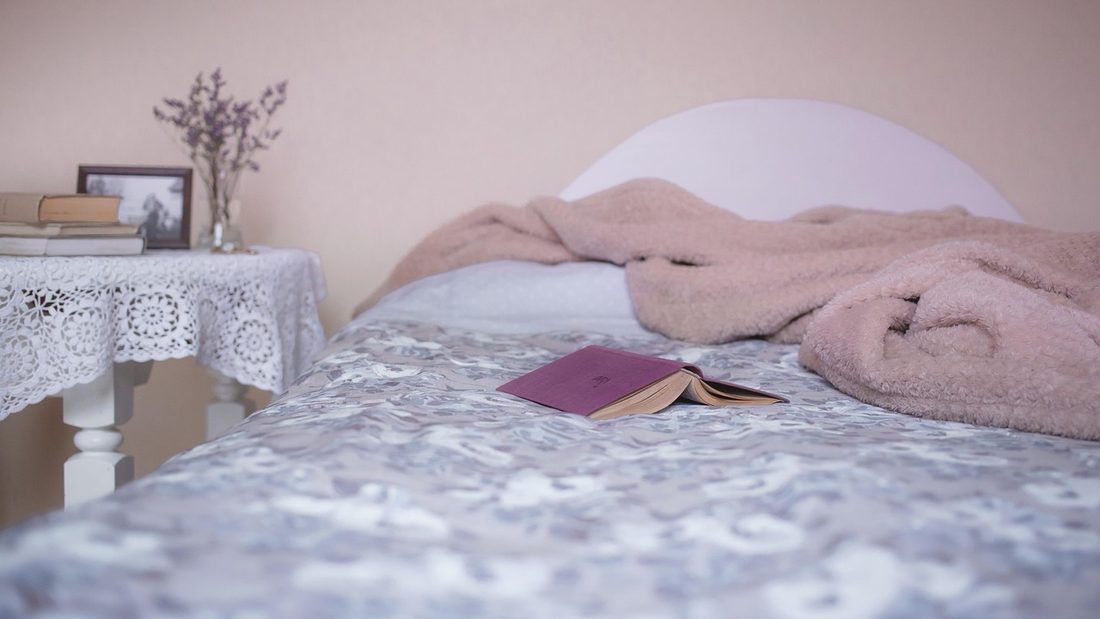
Strip the bed back one layer. If you sleep under a duvet plus a throw plus a synthetic mattress protector, you have built a sealed envelope. Take one layer off and see what happens. Most people discover they were not cold; they were damp.
That is the whole intervention. It costs nothing, and in my case it fixed about seventy per cent of the problem — enough that the remaining thirty per cent was worth spending money on.
The bedding question, which is the one that matters
Once the air is moving, the next variable is what is directly against your skin. This is where the difference between materials stops being a marketing claim and starts being something you can feel at four in the morning.
Polyester and microfibre fill trap moisture. They are cheap, they wash well, and they are the reason hotel rooms feel clammy. A synthetic duvet holds the moisture you produce and returns it to you.
Cotton percale breathes but holds water. It is better than polyester, and it feels crisp, which is why it is popular. But cotton absorbs and retains; a cotton duvet on a humid night ends up feeling heavy.
Linen moves moisture away and dries fast. It is the material that behaves most like a wick. It also creases immediately and looks, to some eyes, untidy. If you can live with that, it is the single best change you can make to a bed.
Wool buffers humidity. Wool absorbs moisture vapour and releases it slowly, which is why a wool duvet feels dry rather than damp. It is warmer than its weight suggests, so a lightweight wool fill is usually enough — the common mistake is buying a heavy one and then sleeping too hot.
The practical version: if you change one thing, change what is directly under and over you, not the mattress.
What is worth buying, and what is not
A fan is the cheapest useful object in this entire problem, with one condition: turn the oscillation off. An oscillating fan sweeps across the room and is audible as it does so. A stationary fan pointed at the bed moves air over you continuously and is much quieter. The point is not to cool the room; it is to keep a layer of moving air against your skin.
An air purifier is a different tool and worth being honest about. It removes particles — dust, pollen, smoke — and it does that well. It does not bring fresh air in. If your problem is a room that smells used by morning, a purifier will not fix it, because the air it is cleaning is the same air.
A hygrometer is a small digital display that tells you the relative humidity. It costs very little and it turns a feeling into a number, which is useful when you are trying to work out whether the problem is moisture or temperature. Some people find this level of measurement absurd. Those people have usually not spent three winters guessing.
What I would not do
I would not buy a new mattress to fix a stuffy room. Mattress marketing is built around the idea that the surface you sleep on is the cause of everything, and it is a very expensive way to discover that the cause was a closed window.
I would not seal the room to keep heat in and then buy a purifier to deal with the consequences. That is two purchases solving a problem created by the first one.
And I would not chase a specific overnight temperature. The number that matters is not on a thermostat; it is whether the air is moving and whether the bedding can dry.
The version that takes a weekend
If you want to do this properly rather than incrementally, the order is:
- Air first. Window wide for ten minutes before bed, door ajar overnight. One week.
- Then bedding. Replace the synthetic layer closest to your body with linen or wool. One week.
- Then measurement. Add a hygrometer and a small fan. Now you can see whether the remaining problem is humidity, temperature, or particles.
- Only then consider filtration. And only if the answer to step three was particles.
The reason for that order is that each step is cheaper than the next one, and the cheap steps solve more of the problem than people expect. Almost nobody who does step one properly needs to do step four.