The short answer. Upgrade the grinder first. Particle size decides how fast everything extracts, and an uneven grind cannot be compensated for by any machine, any temperature, or any technique. A $200 machine with a $90 grinder makes better coffee than a $900 machine with a blade grinder.
The first espresso machine I owned cost more than my sofa. I ran it with a blade grinder for eight months, and I spent most of those months convinced the machine was faulty, because some shots ran in twelve seconds and some choked the basket entirely.
The machine was fine. The grinder was chopping coffee into dust and gravel and throwing it into a basket, and no machine can extract an even bed from an uneven pile.
Why particle size is the variable
Coffee extraction is a surface-area problem. Water contacts the outside of each particle and dissolves things out of it. A small particle has more surface per gram than a large one, so it gives up its contents faster.
If every particle is the same size, the whole bed finishes at the same moment and you get one flavour. If the particles are mixed — dust and boulders in the same bed — the dust is finished extracting while the boulders have barely started, and by the time the boulders are done the dust has given up everything bitter it has.
That is the entire problem in one paragraph. You cannot fix it downstream. Not with a finer setting, because that makes the dust worse. Not with a shorter brew, because the boulders get worse. Not with a different machine, because the machine's only job is to move water through the bed at a controlled rate, and the bed is the problem.
Blade versus burr, concretely
A blade grinder is a spinning blade in a cup. It chops. It chops the pieces nearest the blade most, and the pieces at the top of the pile least, so the output is a distribution from powder to pebbles. The longer you run it, the more dust you make and the more heat you put into the beans.
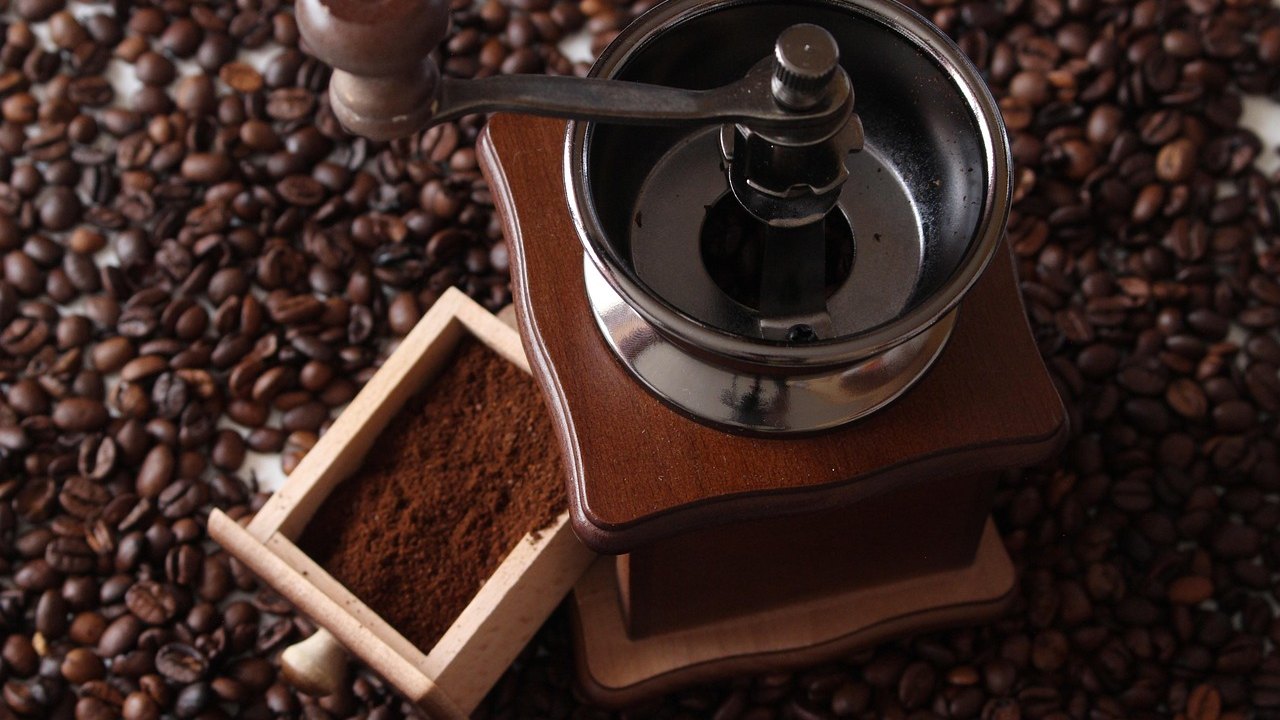
A burr grinder crushes the bean between two abrasive surfaces set a fixed distance apart. Every particle has to pass through that gap, so the output is a narrow band around the setting. That is the whole difference.
Two kinds of burr. Conical burrs are cone-shaped and slower, and generally better at coarse settings. Flat burrs are disc-shaped and faster, and generally better at espresso. For filter coffee at home, either is fine, and the difference between a good conical and a good flat is much smaller than the difference between either and a blade.
The price ladder, honestly
Under $50. Hand grinders with ceramic burrs. They work, slowly, and the grind is inconsistent at coarse settings. A reasonable first step and a waste of money if you already know you will upgrade.
$60 to $120, hand grinder. This is where the value is. Steel conical burrs, external adjustment, consistent enough that people use them for espresso. It takes about forty seconds to grind a dose. If you make one or two cups a day, this is the purchase I would make.
$150 to $250, electric entry level. Conical burrs, timed dosing, a hopper. This is the point where electric becomes genuinely good rather than convenient. Below this, most electric grinders are blade grinders with a burr-shaped label.
$400 and up. Better burrs, better build, quieter, and diminishing returns for filter coffee. The gains are real and they are small.
The rule of thumb I would give anyone: spend more on the grinder than you are comfortable with, and less on the machine than you want to. The machine is a pump and a heater. The grinder is the thing that decides what you are brewing.
Where the rest of the money goes, in order
Beans. Fresh, from a roaster that puts a date on the bag. Stale beans taste stale through any equipment. This is the cheapest upgrade in coffee and the one people skip because it does not feel like equipment.
Water. If your tap water is hard or heavily chlorinated, it is limiting every cup. I wrote about that separately in tap water for coffee, and it costs less to fix than a grinder.
A scale. Fifteen pounds, and it removes the guessing from dose and ratio. Weigh beans in, weigh water in, and you can repeat a cup you liked.
Temperature control. A dial kettle, or ninety seconds of patience. I covered the cheap version in water temperature without a thermometer.
Then the machine. Which, by this point, will be doing the least interesting job in the chain and will be the cheapest part of the setup.
How to tell the grind is the problem
Three symptoms, in order of how reliably they point at the grinder rather than the beans.
The same bag tastes different every morning. If you have not changed anything and the cup moves between bright and harsh, the bed is uneven. A consistent grinder makes a consistent cup, which is the fastest way to find out whether the rest of your method is stable.
The cup is both sour and bitter at once. Sour is under-extraction, bitter is over-extraction, and both in the same mouthful means both happened in the same brew. That is the signature of a wide particle distribution: dust finishing early, boulders finishing late.
The brew time jumps around. In a dripper, a bed of dust and boulders drains unpredictably. Three minutes one day and five the next, with the same weight and the same setting, is a grind problem rather than a technique problem.
There is also a physical test that costs nothing. Put a spoonful of ground coffee on a sheet of white paper and look at it closely. A good grind looks like coarse sand — roughly uniform, with a few larger flakes. A blade grinder's output looks like sand mixed with flour and a scattering of small stones. You can see the problem with your eyes in about four seconds.
One caveat, because this test is easy to over-read. Every grinder produces some fines; that is normal and it is part of how coffee extracts. What you are looking for is proportion. A little flour among the sand is fine. A third of the pile being flour is the thing a burr grinder fixes, and no amount of adjusting the setting will fix it on a blade.
The thing that surprised me
A good grinder makes cheap coffee taste more like itself. That is not the same as better.
If the beans are stale or badly roasted, a consistent grind makes the staleness consistent and easier to identify. That is useful — you stop blaming your technique and start buying better beans — but it is not the transformation the internet promises.
What a grinder actually gives you is repeatability. The same beans, the same weight, the same grind, and the cup tastes the same on Tuesday as it did on Sunday. Once a cup is repeatable you can change one thing at a time and learn something. Without that, you are adjusting four variables at once and calling it taste.
That is the real argument. Not that the coffee immediately becomes excellent, but that it becomes a process you can think about instead of a lottery you re-enter every morning.